


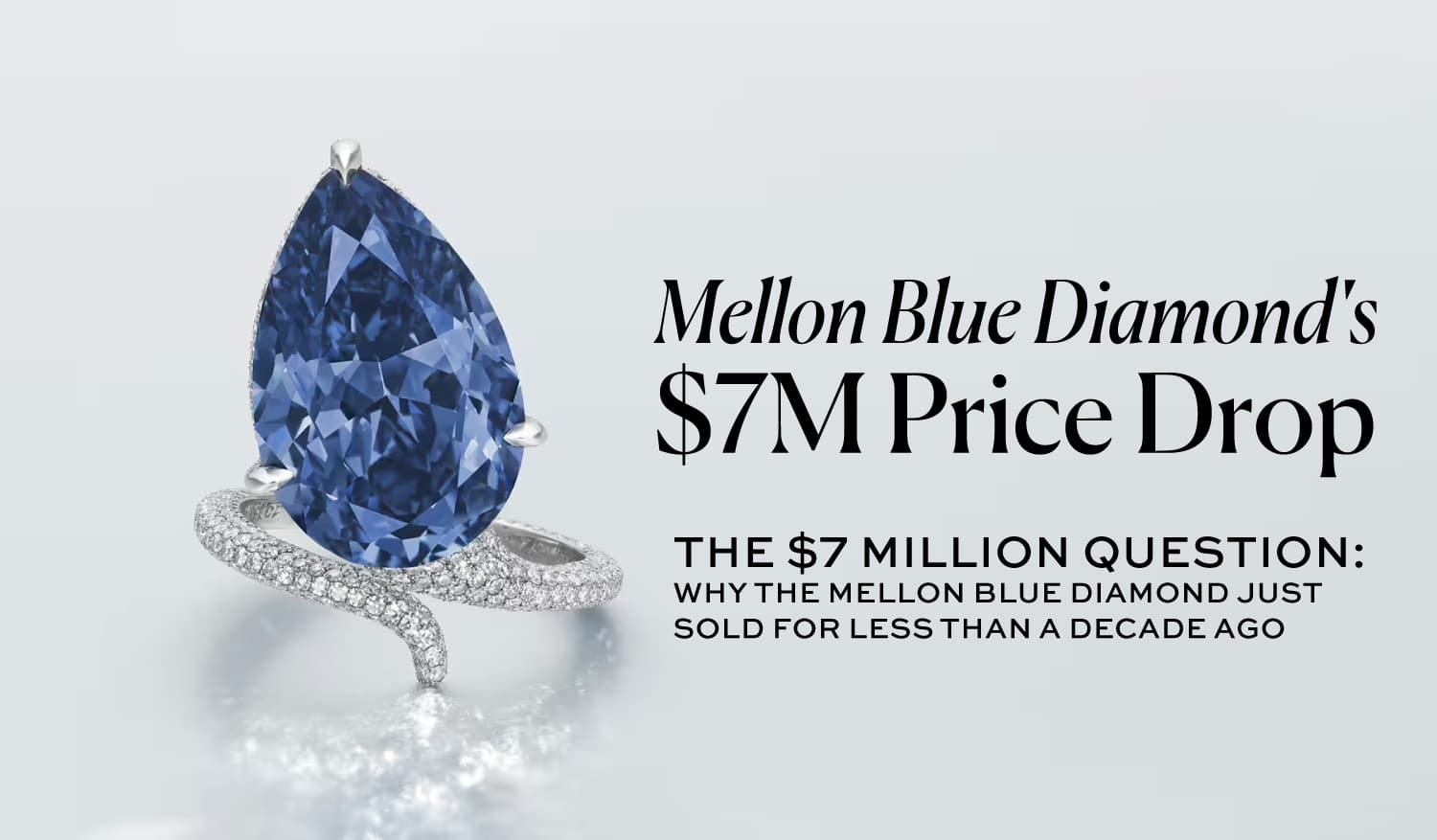
The renowned 9.51-carat Mellon Blue Diamond just sold for $25.6 million at Christie’s—a staggering $7 million less than its record-setting $32.6 million price a decade ago in 2014.
I’m Mehedi, and this result is one of the most fascinating market signals we’ve seen all year. After recently reporting on a Sotheby’s auction that showed a booming high-end market, this seems to fly in the face of everything. The easy conclusion would be that the top of the market is in trouble. But the truth is far more interesting.
So, is the top of the market weakening, or is there a more complex story here? We’re going to dissect this sale, explore the possible reasons behind the price drop, and explain what this really tells us about the ultra-rare colored diamond market.
The Tale of Two Auctions
To understand the significance of this sale, you have to see the numbers side-by-side. We are talking about the exact same exquisite, Fancy Vivid blue diamond with an incredible history, once belonging to the great philanthropist Bunny Mellon. But the auction results from 2014 and 2025 tell two very different stories.
A Head-to-Head Comparison
Let’s use a clear table to show the stark difference in performance.
| Market Metric | Sotheby’s: The Zoe Diamond (2014) | Christie’s: The Mellon Blue (2025) | Net Market Change |
|---|---|---|---|
| Final Hammer Price | $32.6 Million | $25.6 Million | -$7.0 Million |
| Carat Weight | 9.75 Carats | 9.51 Carats | -0.24 Carats |
| Price Per Carat | $3.4 Million | $2.7 Million | -$700,000 |
| Market Significance | Set a then-world record for any blue diamond per carat. | Represented a stabilization in the “Mellon” collection estate prices. | Shift toward value-correction. |
| The 2026 Investment Verdict: This data suggests that while blue diamonds remain the world’s most valuable portable asset, the era of “record-at-any-cost” has transitioned into a more calculated market. Factors like Type IIb classification and historical provenance (like the Mellon estate) are now weighed more heavily than raw size. To see where the market is headed next, explore our full analysis on Rare Diamond Appreciation Trends. | |||
The So What? At the 2014 sale, this diamond set two world records: the highest price paid for a blue diamond and the highest price-per-carat for any diamond at the time. In 2025, while still achieving a massive price, it failed to reach its previous high-water mark—a very rare occurrence for a world-class stone of this caliber.
The Insider’s Analysis: Why Did the Price Fall?
The big question everyone in the industry is asking is, “why did the price drop?” This isn’t a simple case of a failing market. The answer is a fascinating mix of auction psychology, shifting collector tastes, and simple perspective. Here are the likely factors at play.
Reason 1: The Peril of a “High-Water Mark”
The 2014 sale was a legendary, record-shattering event. That kind of result often happens because of a perfect storm: two or more incredibly determined billionaires who both want the same stone and are willing to go to any length to win it.
A fierce bidding war can create a price peak, or a “high-water mark,” that is based as much on ego as it is on the gem itself. When a gem sells at the absolute apex of a moment, it can be very difficult for it to achieve that same price again under different circumstances.
Reason 2: Subtle Shifts in Collector Appetite
The ultra-high-end market is incredibly specific and responds to trends. Over the last decade, we have seen an absolute explosion in the value of fancy vivid pink and red diamonds, which have become the ultimate prize for many top collectors.
It’s possible the market for this specific size and intensity of blue diamond has found a new, more stable valuation level, and that the 2014 price was an outlier. This is a concept I explore in my guide to the Fancy Color Diamond market.
Reason 3: It’s Still an Absolutely Massive Price
Let’s add some much-needed perspective here. Selling a single jewel for $25.6 million is in no way a failure. As Christie’s was quick to point out, this was the most expensive jewel they have sold all year.
The price is still a massive testament to the stone’s incredible rarity, beauty, and quality—all of which are guaranteed and protected by its GIA certification. It reinforces that this gem remains one of the most valuable objects on the planet.
What This Means For The Broader Market (The “So What?”)
It is crucial not to misinterpret this one fascinating result as a sign that the entire high-end market is weakening. The opposite is true. The same Christie’s Magnificent Jewels auction that featured the Mellon Blue still brought in a massive total of $75.6 million.
The event was filled with spectacular successes, like a JAR fancy purplish-pink diamond ring that fetched $3.1 million and a historic ruby brooch that sold for $2.8 million, crushing its estimate.
The key word to describe the current market comes from Max Fawcett, Christie’s new Global Head of Jewelry, who said:
“This season’s Geneva Luxury Week reflects a market defined by confidence and discernment.”“Discernment” is the critical word here. It means buyers are smart, they are selective, and they are paying for true rarity and provenance.
A Lesson for Every Buyer
The ultimate lesson of the Mellon Blue is about understanding true, fundamental value versus auction hype. A bidding war can create a temporary price peak, but the stone’s long-term value will always settle based on its core, certified rarity and quality.
This is why for any significant purchase you make, whether it’s from James Allen or Blue Nile, the reliable, objective data on a certificate from one of the Best Diamond Certifications is your single best guide to its fair and lasting value.
PAA (People Also Ask) – Your Questions, Answered
Who was Bunny Mellon, the original owner of the Mellon Blue?+
Rachel “Bunny” Lambert Mellon was a legendary American horticulturalist, philanthropist, and art collector. As the heir to the Listerine fortune, she was a renowned 20th-century tastemaker who designed the White House Rose Garden for her friend Jacqueline Kennedy. Her jewelry collection, which featured high-level pieces from Maisons like Tiffany & Co. and Schlumberger, is iconic. Owning a gem with her provenance adds a layer of “Old Money” prestige that few other assets can match.
What is a “Fancy Vivid” blue diamond and why is it so rare?+
“Fancy Vivid” is the absolute pinnacle of color intensity on the GIA scale. It signifies a stone with maximum color saturation that is perfectly balanced—not too light and not too dark. In the world of natural blue diamonds, reaching this saturation level requires an incredibly precise concentration of Boron atoms within the crystal lattice, a geological feat that occurs only in the top 0.1% of blue stones.
What is the most expensive diamond ever sold at auction?+
The record for the most expensive diamond sold at auction remains with the CTF Pink Star, which achieved $71.2 million in 2017. For blue diamonds, the leaderboard is dominated by the De Beers Blue and the Oppenheimer Blue, both having surpassed $57 million. These results highlight the status of high-carat colored diamonds as some of the most concentrated forms of portable wealth on earth.
Does this mean investing in high-end diamonds is risky?+
Results like the recent 2025 re-sale of the Mellon Blue for $25.6 million (down from its 2014 peak of $32.6 million) don’t signal fundamental risk, but rather market nuance. It proves that even at the elite level, assets follow cycles. While the stone didn’t hit a new record, its ability to command over $2.5 million per carat in a cautious 2026 economic environment confirms that high-end stones remain stable “Hard Assets” for long-term protection against inflation.
What other famous blue diamonds are there?+
Beyond the Mellon Blue, the world’s most famous blue is the Hope Diamond (Smithsonian). Other legendary stones include the Wittelsbach-Graff Diamond (31.06ct), the Blue Moon of Josephine (12.03ct), and the record-setting Oppenheimer Blue (14.62ct). These stones are considered global heritage treasures and are frequently studied to understand the chemistry of blue diamonds found deep in the Earth’s lower mantle.
Conclusion
The story of the Mellon Blue’s $7 million price drop is not a sign of a collapsing market. It is a fascinating and rare look into the complex, nuanced world of ultra-high-end auctions, where psychology, momentary bidding wars, and shifting collector tastes can create records that are hard to repeat.
It serves as a powerful lesson for every jewelry buyer: focus on the fundamental, certified quality of your gem. That is the true measure of its beauty and its lasting value, free from the momentary drama of the auction block.